Saturday, January 25, 2014

OF Disappointments and Unfairness of Life

Disappointments have a special way of showing up just when you don't need them most. That is the first thought to cross my mind as I watched the train leave the platform. We were supposed to be on that train; however, we could only watch it with dismay from across the tracks. It was a holiday that we had been looking forward to for a very long time; I kept thinking as we dragged our bags back home. If only we had left five minutes earlier, if only there wasn't that much traffic on the road, if only the cabbie had taken a different road; if only...this hadn't happened to me.

Even if this had to happen, I wish it wouldn't have happened today. No!! how could we have missed THIS trip!! The mind wouldn't stop calling this unfair and curse life for being unjust at times. 'At times?!?!'...a second thought smirked its way in. 'Are you not lucky that life is unjust to you only at times. Don't you feel lucky to have so many things come so easily to you?' An image hurried across my mind.

Every time I passed through the market to pick to the missus, I saw this couple sit near a turning. Weary faced, probably in their 80s, this couple sat by the road selling petty things like combs & draw strings; things that don't cost more than 5-10 bucks and things that you would buy only occasionally. How much would they be making daily? 50-60 bucks? or 100 at best? I wonder how fair life would feel if at 80 you are to sit on the road daily to earn 100 bucks in an expensive city like Mumbai.


Sunday, September 9, 2012

A Wild Nesting (Wildernest) In Goa


"The real voyage of discovery consists not in seeking new landscapes, but in having new eyes."

- Marcel Proust (French Novelist and Author)


View of the valley en route to the resorts
Think of a holiday in Goa and the mind immediately renders images of  serene beaches, clear waters, cheap booze(!!), bike rides and wild parties. Never does one imagine hilly terrains, gushing waterfalls, winding roads and wild creatures. However, just like the country that the state resides in, Goa offers much diversity beyond beaches, booze and minerals. Owing to its location between Maharashtra and Karnataka a part of the Western Ghats passes through Goa, providing a biodiversity to the state.


Inside view of the cottages
View from the room
The Western Ghats frame the Eastern and Western borders of Goa, and stretch into Karnataka. Somewhere in the midst of these hills, on a road connecting the capital of Goa - Panaji - to Belgaum in Karnataka lie two secluded natural abodes - Swapnagandha & Wildernest. Nestled 700-800 metres above sea level, these eco friendly resorts are concealed by thick forest covers and offer beautiful views of the forest, valley and a couple of majestic waterfalls. Staying close to nature while offering all the comforts of modern living (except air conditioners) is the key attraction of these mostly word-of-mouth publicised resorts. Guests are logged in to mostly similar looking eco-friendly wooden cottages, with the difference being mostly the view offered from these cottages (one of our rooms had this magnificient view of a pair of 143 mtrs waterfall). While the cottages are eco friendly and made out of wood, they offer enough comfort and amenities for a good stay, with the only exception of an air conditioner.

Wednesday, June 27, 2012

How I (Nearly) Got Kissed By A Lion At Gir National Park

A Young Asiatic Male Lion From The Gir National Park
Asiatic Male Lion
It was a rather quite Saturday morning, our fourth day at the Gir National Park. While my earlier (and first) trip to the Gir National Park was just before the busy season ( in October of 2010, just before the Diwali holidays; read here for details), this time around we chose to go in the busiest season – the summer holidays – as it also  happens to be the best time to spot the wild cats. As it turned out, in the first three days, we had a fairly good amount of sighting of birds, lionesses and cubs, an old male lion and a cheetah!! Boy were we lucky or what?


But greedy as we humans are, we wanted to see a ‘Young Male Lion’ as we (my friend actually!!) weren’t satisfied with what we shot of the ‘Old Male Lion’ two days back. So we started our penultimate day with the usual chore of getting up at 3 and waiting in a queue since 4 in the morning outside Sinh Sadan (the forest department office where permits to enter to the Gir National Park are issued). Finally at 6:30am we managed to get our permits and stacked our tired selves (since were following this routine of standing in long queues twice a day for the last three days) in to the gypsy. We instructed our driver and guide that we had seen enough of most things and would only focus on spotting a ‘Young Male Lion’ in this trip. So they made some calls to find out where this dude was last seen and figured that he was probably somewhere near the end of our trail (each safari permit entitles you to visit one trail, and in one direction i.e. you cannot turn around or travel in the reverse direction, nor can you jump to any other trail).
Dancing Peacock
Dancing Peacock
A Pair of Bee-Eaters
A Pair of Green Bee-Eaters
A Lesser Flameback Woodpecker Feeding Its Little One
Lesser Flameback Woodpecker
Asian Paradise Flycatcher


A Cheetah Flees As It Sees Us
A Fleeing Cheetah
A Small Pride
A Pride of Lions


Thursday, November 10, 2011

Phi Phi Islands - Thailand's Lesser Known Paradise

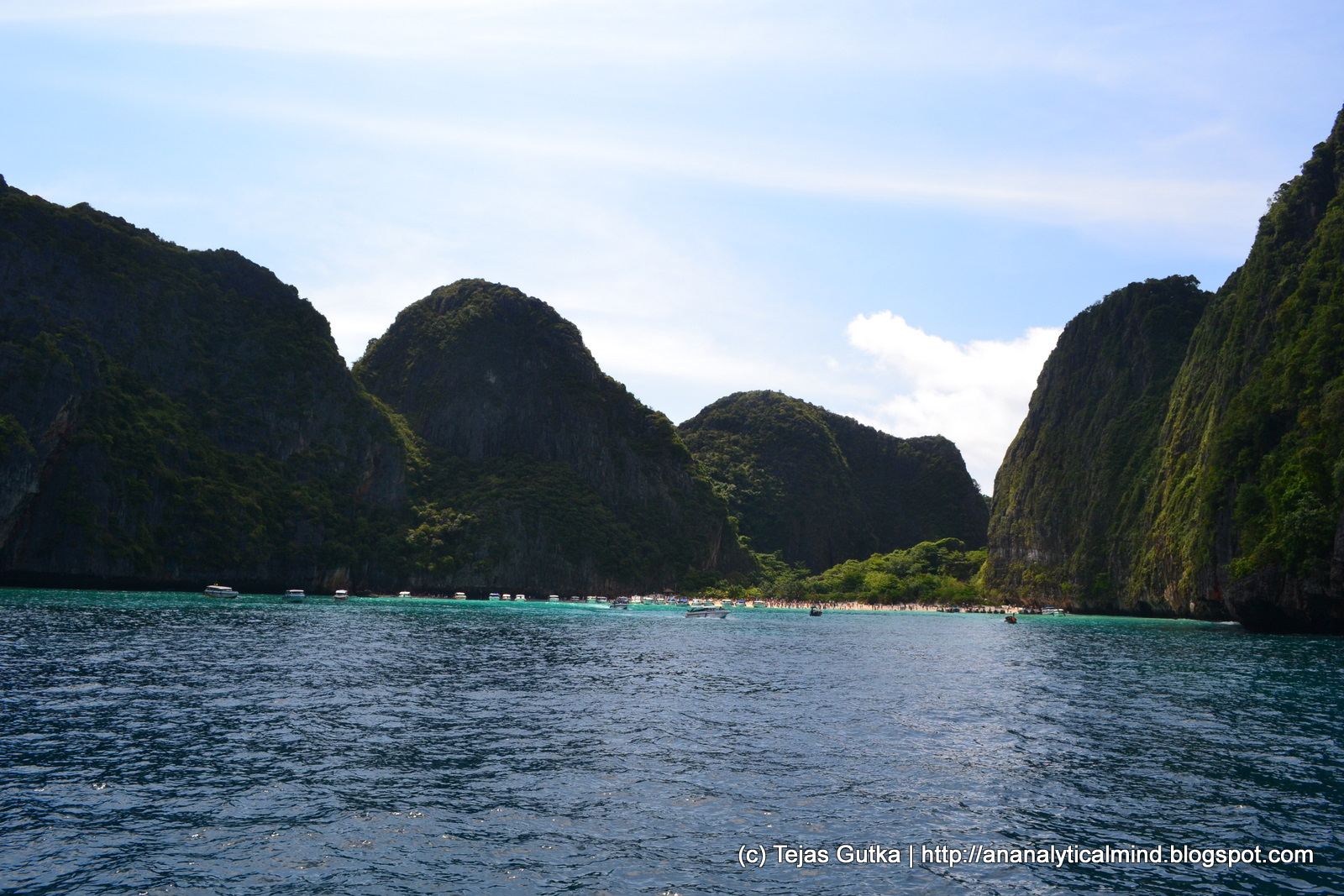
Located near the southern tip of Thailand in the Andaman sea- between Phuket and Krabi - is a pack of small, mostly uninhibited, islands. While each small islet has its own name (Bamboo Islands, Maya Bay, Monkey Islands, James Bond Islands - where the bond film The Man With The Golden Gun [1974, Roger Moore/Christopher Lee] was shot), the pack together is mostly referred to as Phi Phi Islands (locally called as Pi Pi Islands or Ko/Koh Pi Pi). Initially, these islands were frequented by only those seeking adventure and only in recent years have these come on the radar of general holidaymakers. The popularity of these islands can be gauged from the fact that most of them are unidentifiable on Google maps and are mostly visited by the general tourists as part of a one day boat trip. However, a few like us, are lucky enough to be knowing these jewels before planning our trips (we were told, rather insisted, by a couple friend of ours who had visited these islands as part of a day trip, and boy, are we thankful or what!!).


Phi Phi Leh
Phi Phi Don
The largest of the Phi Phi Islands (about 25-30 sq. kms!!) are two identical twins called Phi Phi Don and Phi Phi Leh. When being approached by boat, these islands look like fortresses, as they are covered on one side by tall limestone rocks. While Phi Phi Don is the only inhibited island of all the Phi Phi Islands, Phi Phi Leh houses the famous 'Maya Beach' where the movie The Beach [2000, Leonardo diCaprio] was shot and is thus a famous tourist attraction. Adventure enthusiasts can hook up with some local agencies who can arrange a tent and some food on the Maya Beach for an overnight stay. For regular holidayers wanting to stay, Phi Phi Don is the only option. Although still lesser known compared to destinations like Koh Samui, Phi Phi Don has a variety of hotels across all budgets for those seeking an overnight stay in this  heavenly abode. Like most other beaches in Thailand, these places are characterized by crystal clear waters and pristine white sands; what differentiates them from the regulars though is that these are relatively less crowded and more serene.


Maya Bay
The Beach @ Phi Phi Islands


Friday, July 8, 2011

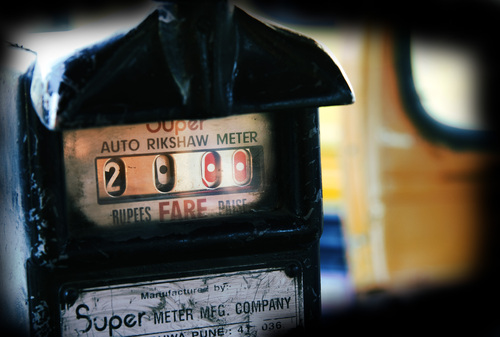
The Economics Of An Autorickshaw...

Photo Credit: http://photos.ibibo.com/photo/1420483/canon-d-autorickshaw-bangalore-india

Circa - Summer of 2006. We were on our way back from Inox Adlabs, Wadala after disappointedly watching The Da Vinci Code. A little ahead of the theatre, towards the highway, we crossed what was going to be my first work place after my MBA. That got us to discussing the vagaries of my travel to Credit Analysis & Research (CARE) Ltd, which was oddly located on the Eastern Express highway, a little before Chembur. Mayuri (fondly referred to as MJ), in her usual candid manner, poped out with a suggestion: “Teja, why don’t u consider buying an autorickshaw and leasing it? That way you can travel to and fro work for free, and also earn rentals!!” Laughter burst immediately, but little did any one think of the economics of MJ’s idea.

Back to 2011 – around the first rains of the season. There exists an unusual relation between rains, potholes and autorickshaws in Mumbai. Inadvertently, with each passing rain, the number of potholes in Mumbai increases at an exponential rate, no matter how often they are repaired. Similarly, one wild shower can cause most autorickshaws to breakdown, irrespective of its age. Surprisingly, no manufacturer has paid any attention to this crucial detail – maybe in next meeting I’ll point this out to them.

In case you are wondering if I have changed my mind about the blog title from ‘economics of…’ to ‘distress of…’ - not just yet; hang on. The reason I ramble about these issues that, had it been for them, then I would not have yet completely understood the economics of autorickshaws. So, getting back to the story, somewhere around the ascent of this year’s monsoon, I was stranded on my way home in a broken-down autorickshaw. Out of curiosity (an-analytical-mind, afterall!!), I initiated a conversation with the driver as to why these autorickshaws break down. As the downpour gained momentum, our conversation drifted from the problems to the finances, and revelations happened.

Being an analyst, I simply couldn’t resist the temptation of running the numbers on an excel sheet and calculating the IRR (Read more on IRR here).  While my first calculations stunned me, I later realised my folly. Nevertheless, I thought this would be an interesting post, and hence here it is. Lets first start with the assumptions: